

Arbovirus ecology, evolution, and epidemiology
We use experimental approaches to study the ecology, evolution, and epidemiology of arthropod-borne (arbo)viruses. Our diverse team uses interdisciplinary methods from the fields of medical entomology, virology, and genomics to investigate how complex interactions between viruses, their arthropod vectors, and the environment influence arbovirus transmission dynamics. Our goal is to increase our understanding of the drivers and barriers of arbovirus transmission to improve prevention and control strategies.
Latest news
-
New preprint alert!
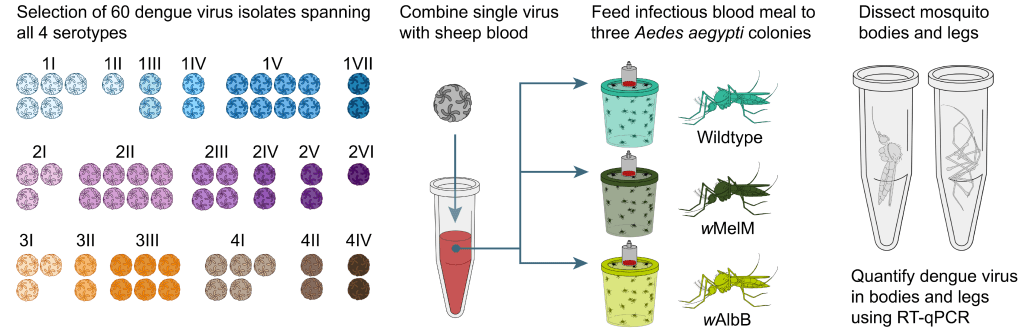
We’re excited to announce that the first preprint from Afeez’s PhD project is now posted on BioRxiv. In this study, we determined the impact of virus genetic diversity on Wolbachia-based control of dengue. We found substantial heterogeneity in inhibition between Wolbachia strains and dengue virus serotypes, which may have implications for potential dengue virus reemergence and strain selection in areas…
-
Welcome to Julian & Scarlett
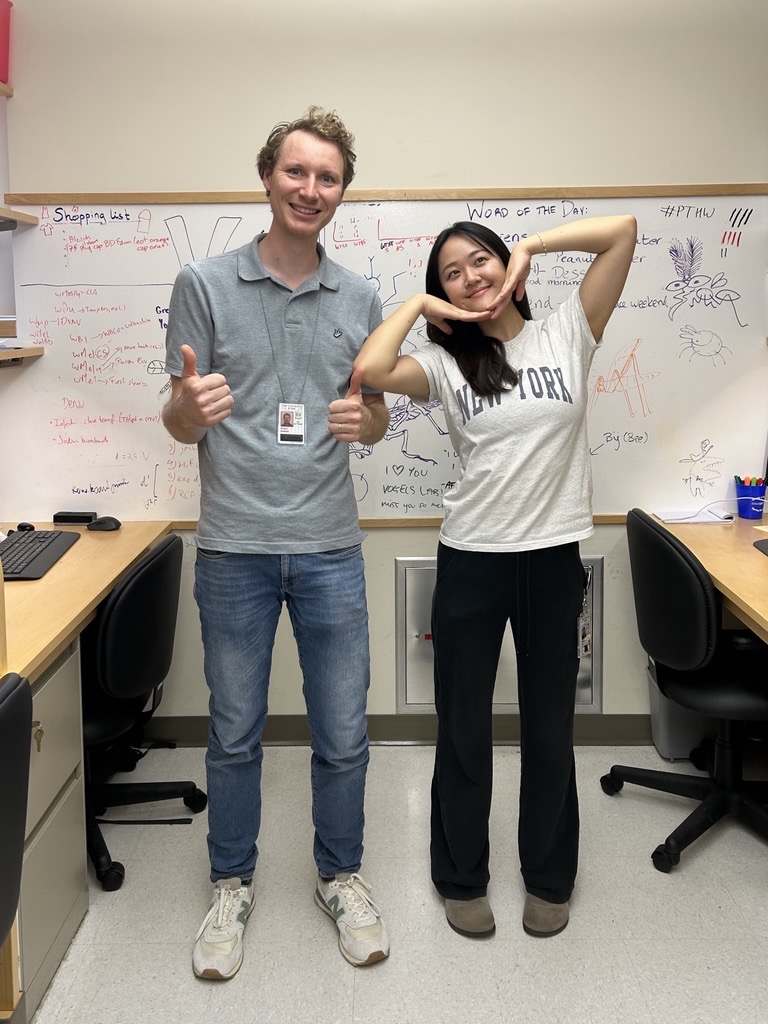
Over the summer we had two new members joining our lab. We’re excited to welcome Julian Bakker and Scarlett An to our growing team! Julian is a Postdoctoral Associate and Scarlett is an MS student in the Epidemiology of Infectious Diseases program. Both will be working on our dengue virus and Powassan virus projects. Stay tuned for their discoveries!
-

Our first Wolbachia paper is now published!
Our paper on the implications of successive blood feeding on Wolbachia-mediated dengue virus inhibition in Aedes aegypti mosquitoes is now published in Nature Communications. In this study we found that successive blood feeding results in earlier dengue virus dissemination in Ae. aegypti mosquitoes, but that the inhibitory effects of Wolbachia remain strong. Our work highlights that Wolbachia can effectively inhibit…
 Vogels Lab